
Rules of the Game
Now that you’ve got the gist of how it works here at PSC, let’s run you through some pickleball rules to get your game on!
The Players
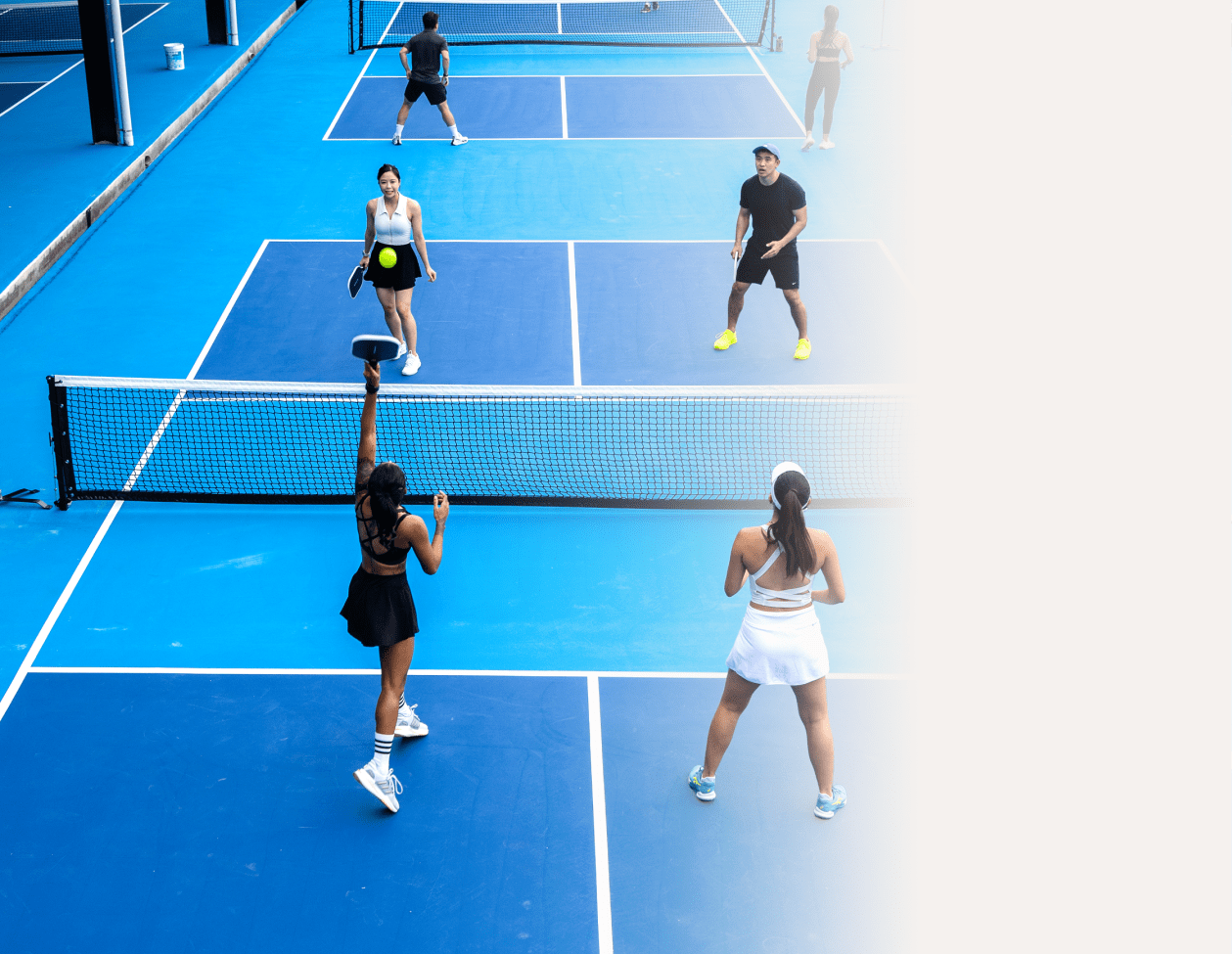
The game is played in either singles or doubles. In singles, both players take turns in serving throughout a match. In doubles, all four players take turns serving and returning throughout a match.
Game On
Serving: The server begins the game from the right side of the court with their serve going cross court to the receiving team. Unlike tennis, all pickleball serves must be underhanded. Like badminton, when a point is scored, the server switches sides and serves from the left-hand court. If the first server loses a rally, their teammate is given the next serve. After the second server loses a rally, the next serve is passed over to the other team.
Scoring: A team can only score points when they are serving.
Rallying: The ball has to bounce on each side before any volleys can begin.
Volleying: A volley is where the ball is hit mid-air before the ball has bounced.


The Kitchen Rule
Volleying a ball is forbidden if your feet are inside the kitchen, even if you’re driven by the momentum of hitting a volley that causes you to step into the kitchen. Once the ball bounces, you are free to step into the kitchen to hit it.
Remember, Kitchen = Non-volley Zone
Calling Out the Score
There are three numbers called in Pickleball; the server score, the receiver score and for doubles, the serve number: one or two. When the game begins, the score looks a little something like this: 0-0-2. So, it will be called out as “zero, zero, two”.
Similar to badminton, the player will serve from the right side of the court if your score is an even number. If your score is an odd number, you should serve from the left side of the court. Be sure to project your voice loud enough when calling out the score prior to serving, so that every player can hear you and to avoid disputes during a close match.

Pickleball Strategy
Ready to conquer the court?
Here’s all you need to know before your next Pickleball session.
Need to brush up your technique and strategy?
Why not book a session with one of our Instructors?
Click the buttons below to find out more.
The Moves
Dink
- The dink is a gentle and strategic shot where you softly drop the ball just over the net.
- Used near the kitchen (non-volley zone), the ball is precisely placed to make it challenging for your opponent to return, setting up for a winning shot.
Lob
A lob involves hitting the ball high and deep into the opponent’s court, usually over their heads.
This defensive shot is effective when your opponents are at the net, providing you with an opportunity to reposition or gain control of the rally.
Ground Strokes
Ground strokes are fundamental shots where you hit the ball after it bounces on your side of the court.
These shots include forehand and backhand drives, helping you maintain control and rally with your opponents during the point.
Drop Shot
The drop shot is a precise move where the ball is lightly tapped, causing it to fall just over the net.
This technique is to catch opponents off guard, forcing them to approach the net quickly and potentially creating an opening for your next shot.
Spinning
Adding spin to the ball creates a strategic rotation during your shot.
Topspin makes the ball dip quickly, while backspin causes it to bounce lower.
Mastering spin enhances your shot variety, bringing a challenge for your opponents to predict and return your shots effectively.